Claude Fable 5 Safety Guardrails Explained for Everyday Users
Anthropic shipped Claude Fable 5 on June 9, 2026, just a few days after it publicly warned that frontier AI is getting capable enough to be genuinely dangerous in a handful of areas. That timing isn't a coincidence. Fable 5 is the most powerful Claude that's been made broadly available, and the safety design reflects that. So this piece walks through how those guardrails work, when they kick in, and what they mean if you're a normal person using it for everyday tasks.
One thing up front: ShadowProof is independent and we're not affiliated with Anthropic. We make a US mobile IP app for creators, and we write plain explainers about tools our readers ask about. We're not here to sell you on the safety approach or to trash it, just to read the release and tell you what it says.
The short version
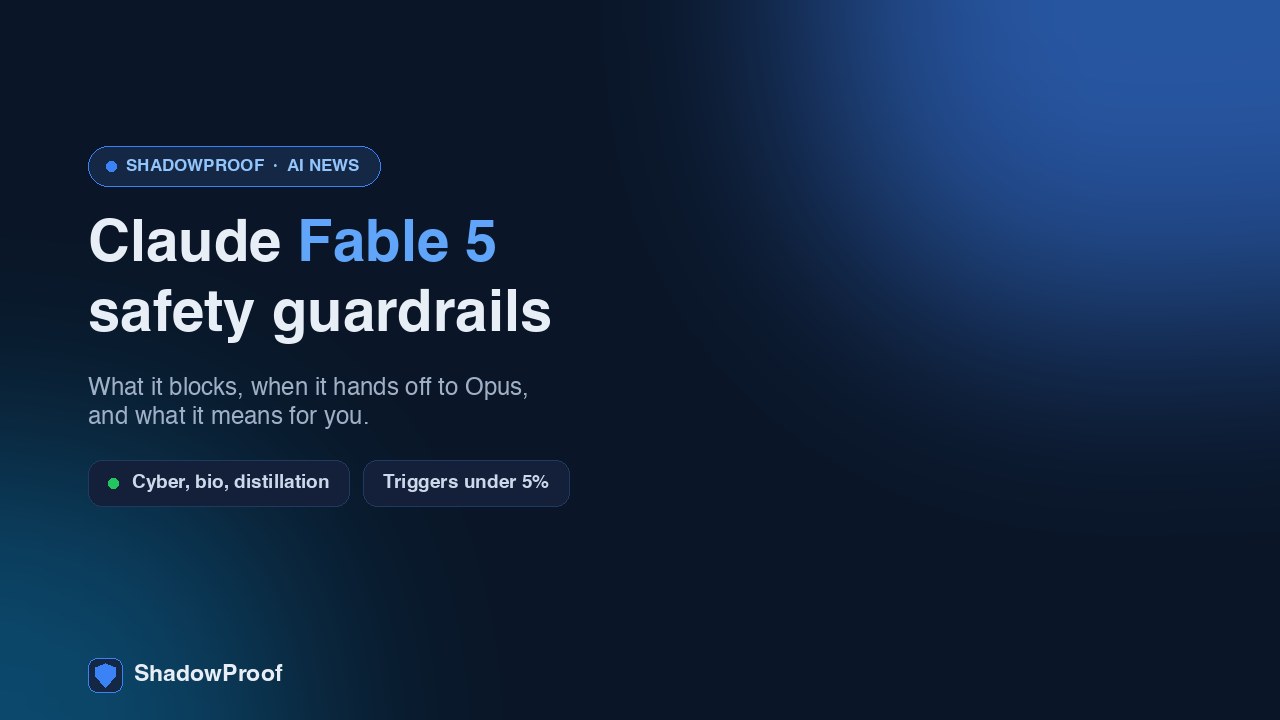
Fable 5 doesn't refuse the touchy stuff outright. Instead it routes certain requests to a different, older, safer model. The handoff is invisible to you in the moment, and for the vast majority of people it never happens at all. The classifiers that trigger it fire in under 5% of sessions on average. For coding, writing, analysis, research, and creative work, you'll almost certainly never bump into them.
That's the whole thing in two sentences. The rest fills in the details, because the details are where people get confused.
The three areas that trigger a fallback
Fable 5 ships with safety classifiers that watch for three specific categories of request. When a request lands in one of them, the system doesn't answer with the full Fable model. It hands the request back to Opus 4.8 instead. Here are the three:
- Cybersecurity. Offensive cyber tasks and exploitation. Think of work aimed at attacking systems rather than defending them.
- Biology and chemistry. This is about avoiding help with dangerous research, the kind of thing that could feed into viral design or similar work.
- Distillation. This one's a little different. It's meant to stop people from extracting the model's capabilities to train a competing model. In other words, you can't easily use Fable 5 as a teacher to clone Fable 5.
The first two are about not helping with genuinely harmful real-world outcomes. The third is more of a guardrail around the model itself. All three share the same mechanism, which is the fallback.
Why a fallback instead of a refusal
This is the part I find interesting. Plenty of models just say no to a sensitive request. Fable 5's design is different: it doesn't slam the door, it sends you to a quieter room. Opus 4.8 is the older model and Anthropic considers it safer in these areas, so a question touching one of the three categories gets answered by Opus 4.8 rather than the full Fable model.
For you, the practical effect is that you might occasionally get a response that came from Opus 4.8 without realizing it. The answer still comes back, just from a model Anthropic is more comfortable letting run on that topic.
How often this actually happens
Under 5% of sessions, on average. That's the number Anthropic published.
Read that carefully, because it's easy to misread. It does not mean 5% of your requests get blocked. It means that across all sessions, fewer than one in twenty trips a classifier at all, and even then the result is a handoff, not a refusal. If your work is normal software, documents, marketing copy, or brainstorming, you're extremely unlikely to ever land in that slice.
So the honest framing for a regular user is: the guardrails are real, and you'll probably never notice them. People doing offensive security research or sensitive bio work are the ones who'll actually feel the boundary. Everyone else gets the full model nearly all the time.
If you want the broader picture of what the model is, we covered that in Claude Fable 5 explained.
The testing and data side
Two more pieces of the safety story are worth knowing before you put real work through any model.
Red teaming
Anthropic had external red teamers run more than 1,000 hours of testing against Fable 5. Their finding: no universal jailbreaks. A universal jailbreak is a single trick that reliably breaks a model's guardrails across the board, and those are the scary ones because they generalize. Not finding one in over a thousand hours isn't a promise that none exists. No model clears that bar. But it's a concrete, measurable result, and a lot more than a vague 'we tested it' statement.
Data retention
Anthropic uses a 30 day retention policy for Mythos-class models, the tier Fable 5 belongs to. The data is not used to train models. That's two separate commitments worth keeping straight:
- Your data sticks around for 30 days, then it goes.
- It doesn't get fed back into training.
If you handle anything sensitive, those are the two facts that matter most, more than any benchmark score.
A quick word on Mythos 5
You'll see the name Mythos 5 floating around, and it confuses people, so here's the relationship. Mythos 5 is the same underlying model as Fable 5, just with some of these safeguards lifted. It's not a public product. Anthropic restricts it to vetted cyberdefense and biology partners, the exact groups who have a legitimate reason to work in the guarded areas.
So if you're using the broadly available model, you're using Fable 5 with the classifiers on. The lifted-guardrail version is locked behind partner vetting, so you won't stumble into it by accident. We put the two side by side in Claude Fable 5 vs Mythos 5 if you want the full breakdown.
What about alignment
One more detail from Anthropic's own assessment, since 'safety' and 'alignment' get blurred together. Anthropic's alignment evaluation said Fable 5's misaligned behavior is similar to Opus 4.8. In plain terms, this much more capable model isn't more prone to going off the rails than the model a lot of teams already trust and run today. The capability jumped. The misalignment profile, per Anthropic's own testing, didn't.
That's Anthropic grading its own homework, so treat it as a self-report rather than an independent audit. If you're weighing Fable 5 against the model it falls back to, our Claude Fable 5 vs Opus 4.8 comparison puts them side by side.
What it means in practice
Pulling it together for a normal user:
- You'll almost never hit a guardrail. Under 5% of sessions trip a classifier, and that's mostly cyber, bio, and distillation work.
- When one does trip, you get an answer from Opus 4.8 rather than a refusal. The conversation keeps going.
- Your data lives 30 days and isn't used for training.
- External testing found no universal jailbreaks across 1,000-plus hours.
If your daily work is the usual mix of coding, writing, and analysis, the safety system is basically invisible furniture. It's there, doing its job in the background, and you can mostly forget about it.
Frequently asked questions
What are Claude Fable 5's safety guardrails?
They're safety classifiers built into Fable 5 that watch for certain sensitive requests and hand those back to the older, safer Opus 4.8 model instead of answering with the full Fable model. The point is to keep the most capable model from being used in a handful of high-risk areas while still returning an answer.
What topics does Claude Fable 5 block?
Three categories trigger the fallback to Opus 4.8: cybersecurity (offensive cyber and exploitation), biology and chemistry (to avoid helping with dangerous research like viral design), and distillation (stopping people from extracting the model's capabilities to train a competitor). Normal coding, writing, analysis, and creative work don't touch these.
Does Claude Fable 5 use my data for training?
No. Anthropic uses a 30 day retention policy for Mythos-class models, the tier Fable 5 is in, and says the data is not used to train models. Your data is kept for up to 30 days and then removed.
How often do the guardrails trigger?
In under 5% of sessions on average. That's not 5% of requests blocked. It means fewer than one in twenty sessions ever trips a classifier at all, and even then the result is a handoff to Opus 4.8 rather than a refusal. For everyday work you almost never hit them.
Give your account a clean US mobile IP
ShadowProof routes your phone through a real US 5G mobile IP with a clean reputation, the kind social networks trust. One tap, no datacenter footprint. Test it with a $5 day pass.